- Employer Resources
- |
- Last Updated: December 08, 2025

Always Be Onboarding: Strategies for Hiring, Engaging & Retaining Top Talent [Q&A and Poll Results]
1. How can I ensure new hires follow through on agreed tasks after onboarding?
Answer: If new hires backtrack on agreed responsibilities, it likely means expectations weren’t reinforced or aligned post-offer. Build expectation checkpoints: revisit offer-letter commitments during onboarding, clarify roles in training, and then monitor early performance so that new employees see the connection between what was agreed and what’s expected.
- Review the offer letter and training modules to ensure they reference the same tasks and responsibilities.
- Implement a 1:1 check-in in the first two weeks to reaffirm the commitment and answer questions.
- Tie early performance milestones (first 30 days) to those original expectations and make them visible.
Recommended Reading:
7 Onboarding Mistakes to Avoid if You Want to Retain Staff
2. How can I motivate new hires to complete onboarding tasks (paperwork, documentation) with a sense of urgency?
Answer: A lack of urgency could signal that the new hire doesn’t yet feel engaged or see the value of the tasks, or they simply forgot. Frame onboarding items not just as “you must complete this” but as enabling them to start contributing meaningfully. Completing tasks quickly unlocks their ability to work at full capacity and ties into their first-day success.
- Create a pre-boarding checklist with clear deadlines and reminders.
- Communicate the “why” of each piece of paperwork: explain how it impacts their payroll, system access, and training schedule.
- Consider linking task completion to a welcome milestone (e.g., “Once you complete onboarding, we’ll send your welcome kit/introduce you to your buddy”).
Recommended Reading:
5 Virtual Onboarding Tips for HR Teams and Managers
3. How can I get managers and team members on board with first-day/first-week onboarding ideas when I’m getting pushback?
Answer: Getting stakeholder buy-in is about linking their involvement to clear business outcomes (faster productivity, lower turnover) and minimizing their burden. Position onboarding as a shared responsibility and gives team members light, well-defined roles, not heavy “extra work” tasks.
- Present onboarding ROI data to managers: how structured onboarding supports retention and performance.
- Divide onboarding tasks into “micro-roles” (e.g., welcome email, teammate intro) to reduce perceived effort.
- Recognize or reward team members who actively participate in onboarding (e.g., shout-outs, small incentives).
Recommended Reading:
7 Ideas to Enhance Your Onboarding Process
4. When should new hires receive their onboarding logistics email (where to go, arrival time, what to bring)?
Answer: The logistics email should arrive three to five business days before the first day. This allows the new hire time to prepare and reduces first-day stress. If there’s remote or complex onboarding, consider sending it even earlier. The key is clarity and ensuring receipt.
- Use a standardized pre-boarding logistics email template and send it once the offer is accepted.
- Include arrival time, location/parking, first-day schedule, contact person, what to wear/bring, etc.
- Follow up with confirmation (e.g., “Please reply that you’ve received this and let me know if you have any questions”).
Recommended Reading:
5. How do I design the “meet & greet” with senior leadership to create impact and alignment for new hires?
Answer: A well-designed meet-and-greet with senior leadership helps new hires feel valued and connects them early on to the company’s purpose and culture. It shouldn’t be simply a “hello” – it should include personal anecdotes, vision, and Q&A to build connection and context.
- Ask senior leaders to share personal stories of how they started and how onboarding helped them succeed.
- Include a short Q&A session where new hires can ask about culture, expectations, or career path.
- Provide a follow-up email summarizing key points from the session and linking them to the company’s “why”.
6. Do structured 30-60-90-day check-ins help with engagement and retention?
Answer: Absolutely. Check-ins at 30, 60, and 90 days provide structure, show commitment to the employee’s growth, and give managers and new hires a regular touchpoint to align expectations. Without them, new hires risk disengaging.
- Schedule the 30/60/90 meeting calendar when the offer is accepted so all parties know the plan.
- Use a standard agenda: review what’s going well, what obstacles exist, and the next goals.
- Ensure the manager follows up on any action items and makes progress visible.
Recommended Reading:
Ask an HR Pro: How Long Does It Take to Onboard an Employee?
7. How should I approach onboarding and orientation for field laborers or manufacturing roles differently?
Answer: Onboarding for field or manufacturing roles needs to emphasize practicality, safety, role clarity, and early success in the work environment. It often requires less corporate talk and more hands-on, visual orientation. The aim is to get them to do productive work safely and feel competent quickly.
- Begin with a facility or field walkthrough on day one. Show them where to go, point out hazards, and introduce them to key people.
- Use job shadowing or buddy systems for the first week so new workers see the role in action.
- Keep paperwork and orientation short and relevant. Focus early on what they’ll actually do and what safety/training they must complete.
8. What’s the one platform or tool that can transform our onboarding experience across tasks, paperwork, and engagement?
Answer: The ideal onboarding platform is one that centralizes pre-boarding tasks (paperwork), schedules training and connections, tracks completion, and sends automated reminders. Choose a system with mobile access and visibility for HR, managers, and the new hire. If implemented well, it reduces manual follow-up and increases new hire momentum.
- Research and select a platform that integrates e-signatures, learning modules, and automated task flows.
- Ensure it sends timely reminders and visible status updates for both HR and the new hire.
- Train managers and HR on using the platform so they can keep the new hire on track.
Recommended Reading:
13 HR Tasks You Can Automate with AI
9. How can I build early engagement with new hires?
Answer: Personal and social touches such as a welcome email with a fun fact, a banner, or assigning a buddy can accelerate cultural belonging and engagement. These elements reduce first-day awkwardness and create early social connection, which supports follow-through on more formal tasks.
- Ask the new hire for a fun fact in pre-boarding and use it in a welcome email or banner to build visibility.
- Assign a buddy from day one who reaches out before the start date and supports the first week.
- Follow up with a “first week check-in” from the buddy and manager to build continuity.
Recommended Reading:
New Hire Orientation Ideas to Foster Employee Engagement
10. How can we fine-tune how many days before the start date we send pre-boarding communications and tasks to ensure timely completion?
Answer: The timing of pre-boarding communications impacts how ready and engaged a new hire is on day one. Sending logistics, tasks, and welcome messages too early can mean they’re forgotten; too late, and you risk first-day issues. A tiered communication schedule works best.
- When the offer is accepted, send a “Welcome and Next Steps” email with a high-level overview.
- Three to five business days before the start, send logistical details and required onboarding tasks.
- The day before, send a reminder email/text and introduce their buddy or point of contact.
Recommended Reading:
How to Ensure Your New Hire Has a Great First Day
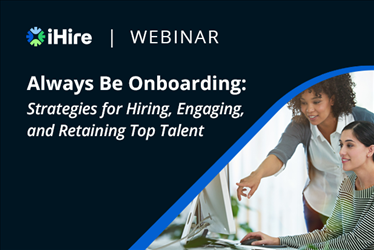
View the on-demand webinar, “Always Be Onboarding: Strategies for Hiring, Engaging, and Retaining Top Talent” at any time, and explore our Resource Center for more onboarding guidance.
RELATED RESOURCES
![The Ultimate Retention Playbook: Keeping Talent Aboard in 2026 [Video Webinar]](https://p-gpb8fhd4b9fbh6fy.z01.azurefd.net/cms/79fd0d62-6ef3-4909-ad73-7a4409281eb8/24f24a71-a30c-4a61-bedd-55b386001997-md.png)
![The Dos and Don’ts of Creating Effective Employee Handbooks [Video Webinar]](https://p-gpb8fhd4b9fbh6fy.z01.azurefd.net/cms/00c354a6-9bdd-4823-9075-3a99e291ae5c/9cf12f2e-915f-4b13-9035-975aea85058c-md.png)
Hiring? You're in the Right Place.
- Reach unique talent: 51% of our candidates aren't using other job boards
- Connect your ATS and get 6x more applications with iHire's apply process
- Get matching candidate resumes sent straight to your inbox
We Value Your Privacy